


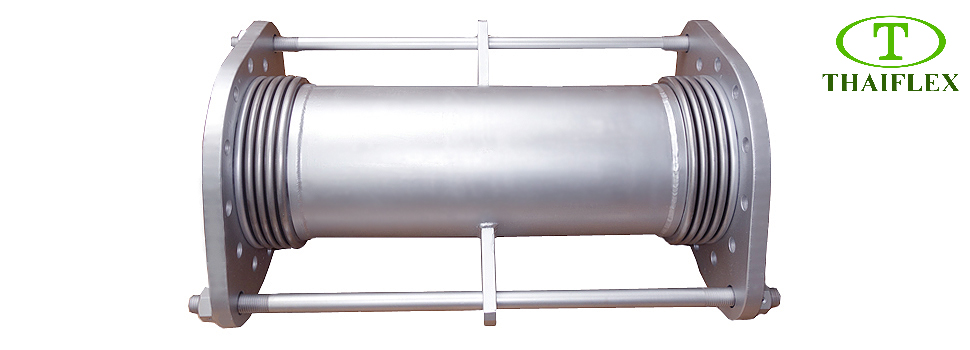
Expansion Joint / Expansion Joints




Primary Application
-
Specially designed for absorbing large amounts of lateral (parallel offset) movement in piping systems.
-
Commonly installed in pipelines crossing building expansion joints, storage tank connections subject to settlement, and low-pressure ducting systems.
-
Ideal for isolating lateral vibrations and protecting connected equipment, such as pumps and turbines, from piping manifold stresses.
Structure & Specifications
-
Bellows: Twin (double) bellows configuration made of Stainless Steel SUS316 separated by a central pipe section (Provides maximum flexibility and excellent chemical and corrosion resistance).
-
Components Material: Available in Mild Steel, SUS304, or SUS316 to suit specific environmental and fluid conditions.
-
Ending Type: Fixed Flanges (For a rigid, secure bolted installation).
-
Tie Rods: Equipped with 2 to 4 tie rods spanning the entire length of the assembly.
-
Inner Sleeve (Liner): (Not specified, but optional inner sleeves can be fitted to prevent flow turbulence).
Movement
-
Axial Movement: No (The full-length tie rods restrain all axial growth and compression).
-
Lateral Movement: Yes (Primary function; the dual-bellows design allows significant parallel lateral displacement in all planes).
-
Angular Movement: No (The tie rod configuration locks the unit against angular deflection).
Key Features & Benefits
-
Large Lateral Displacement: By utilizing two distinct bellows separated by a center spool, this joint can absorb much greater lateral offset than a single expansion joint.
-
Pressure Thrust Restraint: The continuous tie rods completely absorb the internal pressure thrust force. This prevents the bellows from over-extending, eliminates the need for massive main pipeline anchors, and protects delicate equipment nozzles.
-
Stability: The multi-rod structure provides high mechanical stability, preventing bellows squirm and stabilizing the piping layout under high flow velocities.