


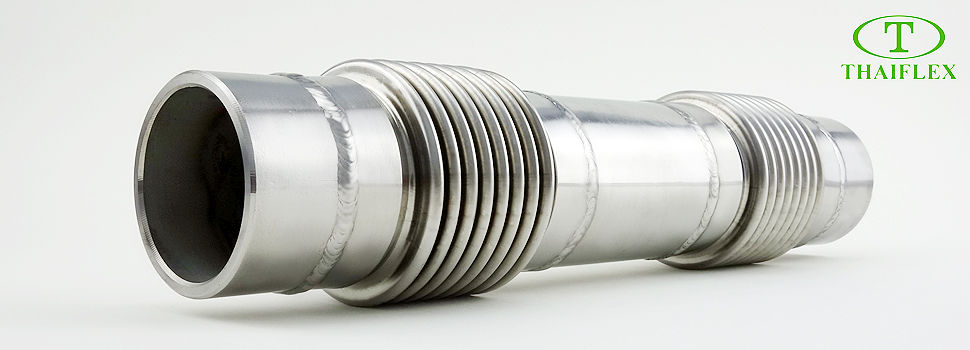
Expansion Joint / Expansion Joint




Primary Application
-
Designed for piping systems that experience multi-directional thermal movements (simultaneous axial, lateral, and angular displacements).
-
Commonly installed in low-pressure pipelines, exhaust gas ducting, ventilation systems, and broad plant piping layouts.
-
Ideal for installations where space is constrained and lightweight configurations are preferred over heavy bolted flange setups.
Structure & Specifications
-
Bellows: Twin (double) bellows configuration made of Stainless Steel SUS316 separated by a central pipe spool (Provides high flexibility and excellent resistance to corrosion and chemical attack).
-
Components Material: Available in Mild Steel, SUS304, or SUS316 depending on application requirements.
-
Ending Type: Tube End (Plain ends designed for direct butt-welding into the pipeline, ensuring a seamless, leak-proof joint).
-
Tie Rods: No (Unrestrained type; the piping system must be equipped with high-quality main anchors and guides to absorb internal pressure thrust).
-
Inner Sleeve (Liner): SUS304 or SUS316 (Protects the dual bellows from high-velocity media erosion and minimizes flow turbulence).
Movement
-
Axial Movement: Yes (Absorbs compression and elongation along the longitudinal pipeline axis).
-
Lateral Movement: Yes (The dual-bellows configuration allows for substantial parallel offset in all directions).
-
Angular Movement: Yes (Accommodates angular rotation and rotational deflections at the joint).
Key Features & Benefits
-
Multi-Directional Flexibility: By combining two bellows with a center pipe section, this unrestrained universal joint can absorb larger combinations of thermal expansion, lateral shear, and angular misalignment than single-bellows units.
-
Lightweight and Compact: The tube-end design eliminates the added weight, bulk, and potential leak paths associated with heavy matching flanges, facilitating a streamlined installation.
-
Low Pressure Drop: The inclusion of an inner sleeve ensures smooth fluid dynamics across both bellows sections, reducing turbulence and preventing product accumulation in the corrugations.