


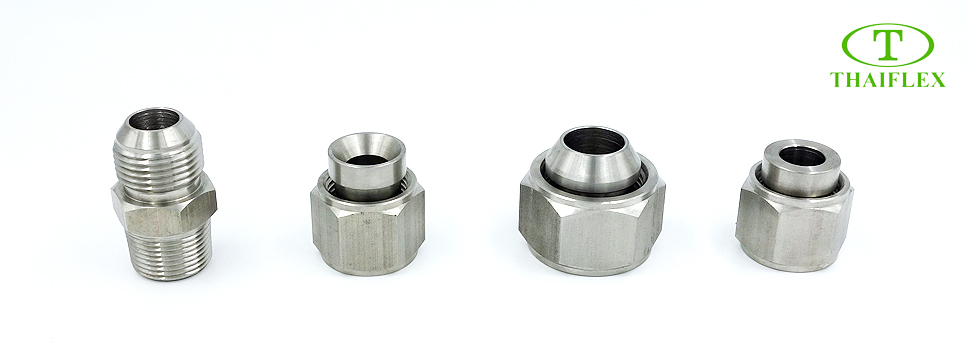
Rubber Expansion Joint / Fitting Female & Male




Primary Application
-
Flexible Hose Fabrication: Used as permanent end-terminations crimped or swaged onto flexible industrial, chemical, and hydraulic hoses.
-
Process Line Integration: Installed on mobile equipment loops, pump connections, and utility lines to facilitate clean, repeatable machine hookups.
-
Chemical & Fluid Utilities: Broadly used across chemical processing plants, water treatment facilities, and food and beverage utility networks.
Structure & Specifications
-
Configuration Options:
-
Male Fitting: Rigid external threaded end for direct connection into stationary manifolds, valves, or female ports.
-
Female NJ (Nut Joint): Swivel-nut design that allows the operator to tighten the connection onto a male thread without rotating the entire hose assembly.
-
Female NU (Nut Union): A specialized union-style female connection featuring an internal mechanical taper/seat to ensure a reliable, metal-to-metal backup seal.
-
-
Material: Premium Stainless Steel (Offers excellent mechanical durability, extended wear life, and outstanding resistance to corrosion, oxidation, and aggressive process fluids).
-
Class / Working Pressure: 150 PSI (Optimized for standard industrial fluid transfer, low-pressure hydraulics, and utility lines).
-
Size Range: 1/2″ to 2″
-
Suitable For: Direct attachment to flexible hoses (via integrated hose shanks or ferrules).
Key Features & Benefits
-
Twist-Free Installation: The female swivel-nut configuration (NJ/NU) rotates independently of the hose stem. This allows operators to easily thread and tighten the connection onto rigid machinery without twisting, kinking, or stressing the flexible hose.
-
Robust Stainless Steel Build: Precision-machined to resist pitting and structural degradation, ensuring long-term purity and a leak-free seal when exposed to moisture, mild wash-down chemicals, or outdoor environments.
-
Optimal Flow Characteristics: Designed with a smooth internal bore that matches the inner diameter of the flexible hose, minimizing system turbulence, preventing material traps, and reducing pressure drops across the connection.