


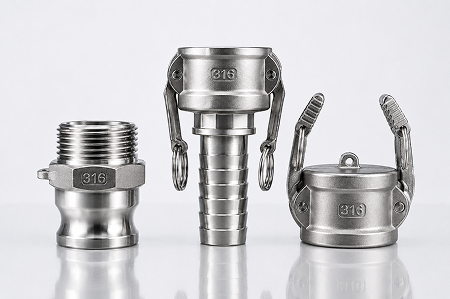
In production lines where liquid or gas transfer lines must be frequently connected and disconnected, Quick Couplings (commonly known as Camlock Couplings) are essential components that save time and significantly enhance workplace safety. However, to maximize efficiency and ensure safe operation, it is crucial to select the correct “material” and “type” based on your specific application requirements.
This article provides a straightforward, 2-step guide to choosing the perfect Quick Coupling.
Step 1: Select the “Material” Based on the Fluid Medium
The base material of a quick coupling directly determines its chemical compatibility, pressure rating, and overall lifespan. There are 4 primary materials used in industrial applications:
-
Stainless Steel (SUS316):
-
Best for: Highly corrosive chemicals, food and beverage processing (Food Grade), pharmaceutical industries, or harsh outdoor environments.
-
Key Advantage: Offers the highest durability, maximum corrosion resistance, and a long service life.
-
-
Aluminum:
-
Best for: General water transfer, petroleum products, fuel delivery trucks, and pneumatic air systems.
-
Key Advantage: Lightweight, easy to handle, and highly cost-effective.
-
-
Brass:
-
Best for: Hot water systems, low-pressure hydraulic applications, or marine environments requiring resistance to saltwater corrosion.
-
Key Advantage: Robust, spark-resistant, and offers better impact resistance than aluminum.
-
-
Polypropylene (PP):
-
Best for: Agricultural applications, mild chemical transfer, or low-concentration acids and alkalis.
-
Key Advantage: The lightest and most economical option with good chemical resistance (Not suitable for high-pressure or high-temperature applications).
-
Step 2: Select the “Type” Based on Your Connection Setup
Camlock quick couplings are categorized into standard letter codes from A to H, consisting of Male Plugs (Adapters) and Female Sockets (Couplers) that pair together:
-
Type A (Male Adapter – Female Thread): Used to screw onto male-threaded pipes, valves, or fittings.
-
Type B (Female Coupler – Male Thread): Features cam arms and screws into female-threaded equipment.
-
Type C (Female Coupler – Hose Shank): Features cam arms with a barbed end designed to slip inside a hose, secured with a hose clamp.
-
Type D (Female Coupler – Female Thread): Features cam arms and screws onto male-threaded pipes or fittings.
-
Type E (Male Adapter – Hose Shank): Features a barbed end designed to slip inside a hose.
-
Type F (Male Adapter – Male Thread): Screws into female-threaded equipment or manifolds.
-
Type DC (Dust Cap): A female coupler with cam arms used to seal off the end of a male adapter to prevent dust and contamination.
-
Type DP (Dust Plug): A solid male adapter used to plug a female coupler when the line is not in use.
Summary: Crucial Factors to Check Before Purchasing
Beyond selecting the material and type, always verify these 3 critical parameters before ordering:
-
Size: Ensure the nominal coupling size matches your pipe or hose diameter.
-
Gasket Material: Choose the right seal compound—such as NBR (for oils), EPDM (for heat/chemicals), or Viton/PTFE (for aggressive media)—to prevent leakage.
-
Working Pressure: Verify that the system operating pressure does not exceed the maximum pressure rating specified for that coupling size and material.
THAIFLEX Recommendation: If you are uncertain about the chemical compatibility of your fluid medium or need assistance choosing the right gasket compound, please share your operational parameters with our engineering team at THAIFLEX for professional technical support.